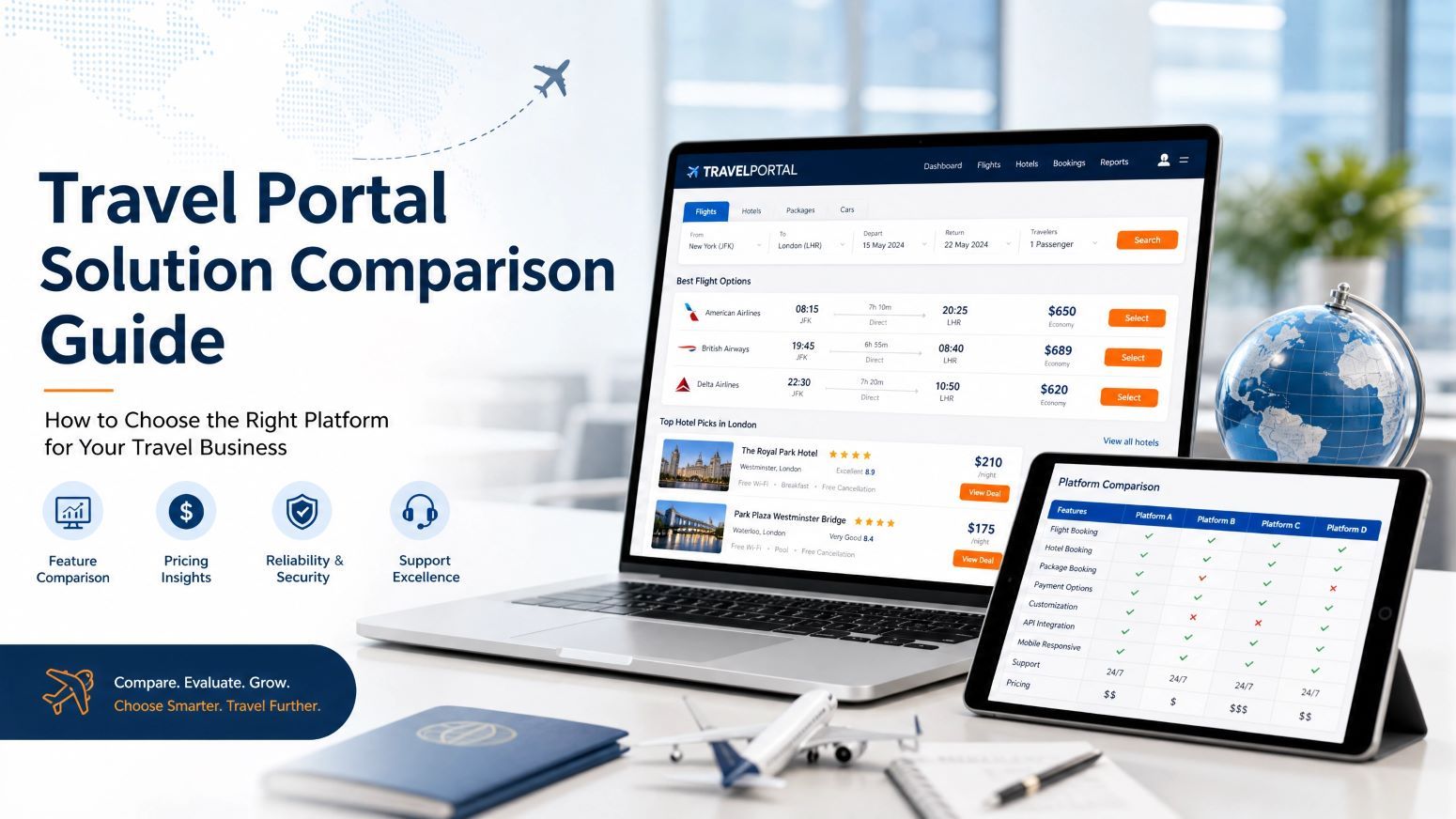
Travel Portal Solution Comparison Guide: How to Choose the Right Platform for Your Travel Business
The global travel industry is more competitive than ever. Whether you're launching an Online Travel Agency (OTA), modernizing a traditional travel agency, or expanding into corporate travel, the technology you choose today will directly impact your future growth.
Unfortunately, many businesses invest in the wrong Travel Portal Solution because they focus only on price or appearance instead of scalability, supplier integrations, and long-term business goals.
The reality is simple: there is no single travel portal solution that fits every business.
A startup has different requirements than an established travel agency. A Destination Management Company (DMC) needs different functionality than a corporate Travel Management Company (TMC). Likewise, a B2B wholesaler and a consumer-facing OTA require completely different workflows.
This guide compares the most common types of Travel Portal Software, explains where each one fits, and helps you choose the right platform for your business.
Why Choosing the Right Travel Portal Solution Matters
A travel portal is much more than a booking website.
It becomes the operational backbone of your business by managing:
- Flight bookings
- Hotel reservations
- Holiday packages
- Transfers
- Activities
- Agent management
- Customer accounts
- Payments
- Reports
- Supplier integrations
Changing platforms after your business grows can be expensive and disruptive. Selecting the right solution from the beginning saves time, money, and future migration efforts.
First, Understand Your Business Model
Before comparing software vendors, define what kind of travel business you're building.
Startup OTA
Typical goals:
- Launch quickly
- Validate the business
- Minimize initial investment
- Scale gradually
Recommended solution:
✔ White Label Portal or Modular Custom Development
Traditional Travel Agency
Typical goals:
- Reduce manual work
- Accept online bookings
- Improve customer experience
Recommended solution:
✔ Custom Travel Portal with B2C Booking Engine
Tour Operator
Typical goals:
- Sell customized itineraries
- Manage departures
- Dynamic package pricing
Recommended solution:
✔ Package Management System with Booking Engine
DMC (Destination Management Company)
Typical goals:
- Manage local inventory
- B2B Agent Network
- Transfers
- Sightseeing
- Hotels
Recommended solution:
✔ B2B Travel Portal with Supplier Management
Corporate Travel (TMC)
Typical goals:
- Approval workflows
- Corporate accounts
- Travel policies
- Reporting
- Expense integration
Recommended solution:
✔ Enterprise Travel Portal
White Label vs Custom Travel Portal Solution
This is probably the most common question businesses ask.
| White Label Portal | Custom Travel Portal |
|---|---|
| Lower initial cost | Higher initial investment |
| Quick launch | Longer development time |
| Limited customization | Fully customized |
| Shared architecture | Dedicated architecture |
| Limited flexibility | Unlimited flexibility |
| Vendor dependency | Complete ownership |
| Suitable for startups | Best for growing businesses |
When White Label Makes Sense
Choose a White Label portal if:
- You want to launch within weeks.
- You're testing the market.
- Budget is limited.
- Standard workflows meet your needs.
- Little control over your platform.
When Custom Development Is Better
Choose custom development if:
- Your business has unique workflows.
- You need multiple API integrations.
- You expect rapid growth.
- You want complete control over your platform.
SaaS vs Self-Hosted Travel Portal Software
Many software providers offer SaaS platforms, while others develop self-hosted solutions.
SaaS Advantages
- Faster deployment
- Lower maintenance
- Automatic updates
- Predictable monthly pricing
SaaS Limitations
- Limited customization
- Vendor lock-in
- Restricted access to source code
- Feature requests depend on the provider
Self-Hosted Advantages
- Complete ownership
- Greater flexibility
- Better performance optimization
- Easier integration with third-party systems
For businesses planning long-term growth, self-hosted or cloud-hosted custom solutions often provide greater flexibility.
Cloud-Based vs On-Premise Deployment
Modern travel businesses increasingly prefer cloud infrastructure.
Cloud Deployment
Advantages include:
- Automatic scaling
- High availability
- Faster disaster recovery
- Lower hardware investment
- Global accessibility
Best for:
- Growing agencies
- OTAs
- International businesses
On-Premise Deployment
Suitable when:
- Regulatory requirements demand local hosting.
- Internal IT teams manage infrastructure.
- Legacy systems require local integration.
For most businesses starting today, cloud deployment offers better scalability and operational efficiency.
Single Supplier vs Multi-Supplier Integration
This decision significantly impacts pricing and inventory.
Single Supplier
Advantages:
- Simpler implementation
- Lower integration effort
Limitations:
- Limited inventory
- Less competitive pricing
- Higher dependency on one provider
Multi-Supplier Platform
Advantages:
- Broader inventory
- Better pricing
- Improved availability
- Automatic supplier fallback
- Higher booking conversion
A multi-supplier strategy is generally the better choice for agencies aiming to grow and remain competitive.
Essential Features Every Travel Portal Solution Should Include
Regardless of your business model, your platform should support:
- Flight booking engine
- Hotel booking engine
- Holiday package management
- Multi-currency support
- Multi-language capability
- Responsive design
- Secure payment gateways
- Customer dashboard
- B2B agent management
- Booking reports
- CRM integration
- API integration
- Promotional offers
- User roles and permissions
- Analytics dashboard
These features form the foundation of a scalable travel platform.
Decision Matrix: Which Travel Portal Solution Fits Your Business?
| Business Type | Recommended Solution |
|---|---|
| Startup OTA | White Label Portal |
| Small Travel Agency | Custom B2C Portal |
| Growing Agency | Custom B2B + B2C Portal |
| DMC | B2B Portal with Supplier Management |
| Tour Operator | Package Management Portal |
| Corporate Travel | Enterprise Travel Portal |
| Online Marketplace | Multi-Supplier Custom Platform |
Questions to Ask Before Choosing a Travel Portal Provider
Before signing a contract, ask your technology partner:
- Which GDS and NDC APIs have you integrated?
- Can multiple suppliers be connected simultaneously?
- Who owns the source code?
- Is the platform mobile responsive?
- Can it support multiple currencies and languages?
- How is data backed up?
- What security standards do you follow?
- How are software updates delivered?
- Can new modules be added later?
- What post-launch support is included?
The quality of the answers often reveals the provider's real experience.
Common Mistakes Businesses Make
Avoid these costly errors:
Choosing the Cheapest Option
Low-cost solutions often lack scalability and customization.
Ignoring Future Growth
A platform that works for 100 bookings may struggle with 10,000.
Depending on One Supplier
Supplier outages can directly affect your revenue.
Forgetting Mobile Users
A poor mobile experience can reduce conversions.
Overlooking Support
Reliable technical support is essential for a mission-critical platform.
Future-Proof Your Investment
Travel technology continues to evolve. A modern travel portal should be ready for:
- AI-powered travel recommendations
- Dynamic pricing
- Personalized offers
- Voice search
- Mobile-first experiences
- Advanced reporting
- API-first architecture
- Real-time supplier switching
Choosing a platform built for future enhancements helps protect your investment.
Final Thoughts
The best Travel Portal Solution isn't necessarily the one with the most features—it's the one that aligns with your business model, growth plans, and customer expectations.
A startup may benefit from a White Label solution for faster market entry, while an established travel agency or OTA often gains greater long-term value from custom travel portal software tailored to its operations.
Before making a decision, evaluate scalability, supplier integrations, deployment options, customization, ownership, and ongoing support. Taking the time to choose the right platform today can save significant costs and create a stronger foundation for future growth.
Whether you're launching your first online travel business or upgrading an existing system, selecting the right travel portal solution is a strategic investment that can improve operational efficiency, customer satisfaction, and long-term profitability.
Considering the next evolution of your booking architecture?
We invite you to an open, confidential discussion about your strategic goals. Together, we can review your existing infrastructure, explore modern solutions that align with your vision, and draft a high-level roadmap for your next phase of growth—with absolutely no obligation to partner with us.
View More Articles

Google Flights API
Instead of being a traditional airline reservation system or GDS, Google Flights helps travelers discover and compare flight options from airlines, OTAs and other travel partners.

Sabre API Integration for Tour Operators
Discover how Sabre API integration can help tour operators build flight, hotel, cruise and multi-product booking platforms with scalable travel technology.

Sabre Api Integration Guide
Learn how Sabre API integration works for travel businesses. Explore flight search, booking, PNR management, architecture, certification requirements, challenges and implementation planning.

Launch Online Travel Business Without White Label
Launch an Online Travel Business in One Week Without Being Locked Into a White-Label Platform

How to Start an Online Flight Booking Business
Learn how to start an online flight booking business with limited upfront investment, including GDS/API options, technology costs, MVP strategy and partnership models.

Holiday Program Booking Software For Travel Agents And OTAS
Discover holiday program booking software with a powerful B2C & B2B holiday package builder. Let customers create, customize, and book holiday packages online.
Airline Reservation System Trends 2026 and Beyond
Elevating Air Travel: The Indispensable Role of Advanced Airline Reservation Systems in 2026 and Beyond
Travel Portal Solution Checklist
Choosing the Right Travel Technology Partner? 16 Questions Every Travel Agency & OTA Should Ask Before Choosing a Technology Partner & Avoid Costly Mistakes.
Why Every Travel Agency Needs a Holiday Package Builder in 2026
Learn how Holiday Package Builder Software helps travel agencies and OTAs automate package creation, increase bookings, improve customer experience, and grow revenue.

how to build right travel portal solution for your travel agency
Sopra Travel Technology builds advanced Flight Booking Portals and Travel Technology Platforms designed for travel agencies, OTAs, consolidators, tour operators, startups, and enterprise travel companies worldwide.
FAQs (Frequently Asked Questions)
Should I choose a White Label or Custom Travel Portal?
White Label solutions are ideal for startups that need a faster launch and lower upfront costs. Custom travel portals are better suited for businesses that require unique workflows, advanced integrations, scalability, and full ownership of the platform.
Is cloud hosting better than on-premise for travel portal software?
For most modern travel businesses, cloud hosting provides better scalability, reliability, and easier maintenance. On-premise deployment is generally preferred only when regulatory or internal infrastructure requirements demand it.
Can travel portal software support both B2B and B2C operations?
Yes. Many modern travel portal solutions offer B2B, B2C, and B2B2C functionality within a single platform, allowing agencies to serve travel agents, corporate clients, and direct consumers from one system.