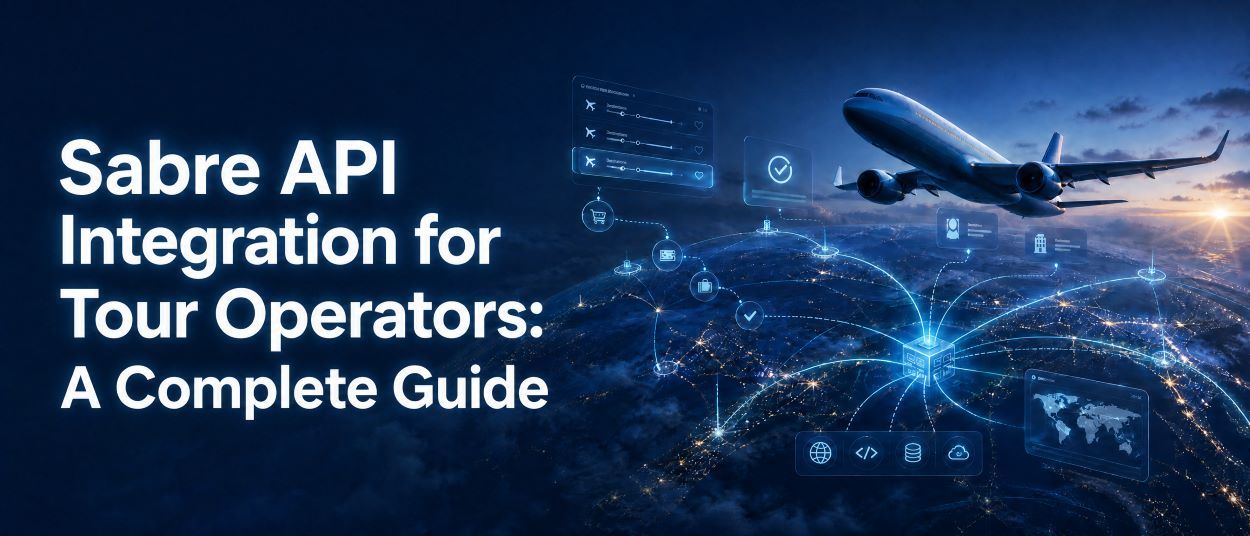
Sabre API Integration for Tour Operators: A Complete Guide
Tour operators are no longer competing only on destination, itinerary or price. Increasingly, they are competing on how quickly and efficiently customers can search, customize and book their entire journey online.
A modern tour operator may need to combine flights, hotels, transfers, activities, packages and other travel products into a single customer experience. Behind that experience is a complex technology ecosystem connecting the operator's website or booking platform with multiple travel suppliers and distribution systems.
This is where Sabre API integration can become an important part of a tour operator's technology strategy.
By connecting relevant Sabre APIs to a custom booking platform, tour operators can integrate travel content into their own digital experiences instead of relying entirely on disconnected supplier websites or manual booking processes.
However, integrating Sabre into a tour operator platform is more than connecting a flight search API.
The real challenge is designing an architecture that can combine supplier content with the operator's own products, pricing rules, packages, customer management and operational workflows.
This guide explains how Sabre API integration can fit into a tour operator's technology ecosystem, what should be considered before development, and how the same architecture can potentially support additional products such as cruises.
What Is Sabre API Integration for Tour Operators?
Sabre API integration is the process of connecting a tour operator's website, booking engine, travel portal or internal application with relevant Sabre technology services.
Depending on the business model, commercial agreement and APIs available to the operator, the integration can support travel shopping, reservation and servicing workflows.
For a tour operator, the important question is not simply:
"Can we connect Sabre to our website?"
The more important question is:
"How can Sabre content become part of our complete tour-product and booking workflow?"
A well-designed integration may allow the operator to combine externally sourced travel content with its own products and business rules.
For example:
Customer → Tour Package → Flight → Hotel → Transfer → Activities → Booking
The technology platform can act as the orchestration layer connecting these components while maintaining a consistent customer experience.
Why Tour Operators Need Travel API Integration?
Traditional tour operations often involve a combination of supplier websites, desktop systems, emails, spreadsheets, internal databases and manually managed booking processes.
That approach may work at smaller volumes, but it can become increasingly difficult as the business expands its destinations, products and customer base.
A connected travel technology platform can help tour operators move toward a more centralized digital workflow.
Real-Time Travel Content
API connectivity can provide access to relevant supplier content and availability through the operator's own application.
This can reduce dependence on manually checking multiple supplier systems during the booking process.
Faster Booking Workflows
Customers and travel agents can potentially search and book travel products from a single platform instead of moving between multiple systems.
Custom Pricing and Markups
A tour operator may need to apply its own commercial rules to supplier content.
The application can be designed to incorporate:
- Markups
- Discounts
- Customer-specific pricing
- Agent commissions
- Promotional rules
- Package pricing
The exact implementation depends on the operator's commercial model and the capabilities of the connected suppliers.
Better Control Over the Customer Experience
Instead of sending customers to a third-party booking interface, operators can build their own branded search and booking experience.
This gives the business greater control over:
- User interface
- Customer journey
- Package presentation
- Pricing display
- Upselling
- Customer communication
- Booking management
Foundation for Multi-Supplier Connectivity
Perhaps most importantly, the architecture does not have to stop with one supplier.
A tour operator may eventually need to connect:
- GDS platforms
- Direct airline APIs
- Hotel suppliers
- Cruise content
- Transfer providers
- Activity providers
- Payment systems
- CRM and back-office systems
A properly designed integration layer can become the foundation for this broader ecosystem.
How Sabre Fits Into a Tour Operator Booking Platform?
A tour operator's technology platform usually contains more business logic than a standard flight booking website.
The operator may already have its own:
- Destinations
- Packages
- Hotels
- Transfers
- Activities
- Pricing
- Customer database
- Agent network
- Contracted inventory
Sabre connectivity can therefore become one component of the larger platform.
A simplified architecture might look like this:
Customer / Travel Agent
↓
Tour Operator Website or B2B/B2C Portal
↓
Booking & Package Management Layer
↓
Travel Integration / Middleware Layer
↓
Sabre + Other Travel Suppliers
The middleware layer becomes particularly important because it can separate supplier-specific API logic from the tour operator's core business logic.
Sabre Flight Integration for Tour Packages
Flights are often one of the most important externally sourced components of an international tour package.
A tour operator may want customers to search for flights while selecting a destination package.
A typical workflow could look like:
Step 1: Select Destination
The customer chooses a destination, package or travel date.
Step 2: Flight Search
The platform sends the relevant search parameters to the connected flight supplier.
Step 3: Display Available Options
Flight options can be presented alongside the tour package according to the operator's business rules.
Step 4: Validate the Selected Offer
Because airline availability and pricing can change, the selected flight may need to be validated or repriced before booking.
Step 5: Create the Reservation
The platform submits the required traveler and itinerary information through the relevant booking workflow.
Step 6: Complete the Package Booking
The flight reservation can then be associated with the operator's wider package or customer booking record.
The exact workflow will depend on the APIs, commercial arrangements and package architecture being implemented.
Building a B2C Tour Operator Platform With Sabre
A B2C tour operator platform is designed primarily for consumers.
The customer may expect to:
- Search a destination
- Select travel dates
- View package options
- Select or customize flights
- Select accommodation
- Add transfers or activities
- Review the complete price
- Make payment
- Receive booking confirmation
This creates an important architectural requirement.
The system needs to distinguish between supplier pricing and the final package price presented to the customer.
For example:
Supplier Content
↓
Operator Markup
↓
Hotel / Transfer / Activity Components
↓
Commercial Rules
=
Customer Package Price
The booking platform should be designed so that supplier integration and package pricing remain separate layers.
That makes the system easier to maintain and expand.
Building a B2B Tour Operator Platform With Sabre
B2B tour operators have different requirements.
Their customers may be:
- Travel agencies
- Sub-agents
- Corporate travel partners
- Resellers
- Affiliate businesses
The platform may therefore require features such as:
- Agent login
- Agent-specific pricing
- Credit limits
- Markups
- Commission rules
- Booking history
- Customer management
- Invoicing
- Reports
- Role-based access
Sabre connectivity can sit behind this B2B platform while the operator maintains control over the commercial and operational rules.
This is one reason why a direct API integration can be more valuable than simply embedding a generic booking widget.
Sabre API Integration and Tour Package Management
One of the biggest technical considerations for tour operators is that a package is not necessarily the same thing as a supplier booking.
A tour package might contain:
- Flight
- Hotel
- Airport transfer
- Sightseeing
- Activity
- Insurance
- Visa assistance
- Cruise
- Other operator-managed services
Some components may come from external APIs while others may come from the operator's own inventory.
The booking platform therefore needs a central booking model capable of tracking the complete customer journey.
For example:
Package ID
→ Customer
→ Travelers
→ Flight reservation
→ Hotel reservation
→ Transfer
→ Activity
→ Payment
→ Final itinerary
This allows the operator to maintain one customer-facing booking experience even when the underlying products come from different systems.
Sabre Integration With Other Travel APIs
A growing tour operator should avoid designing its technology around a single supplier whenever the long-term business model requires multiple sources of inventory.
A scalable architecture can potentially combine Sabre with:
- Direct airline APIs
- Other GDS providers
- Hotel APIs
- Cruise suppliers
- Transfer APIs
- Activity APIs
- Payment gateways
- CRM platforms
The purpose of middleware is to manage this complexity.
Instead of building the frontend around supplier-specific data structures, the platform can normalize information into internal business models.
For example:
Supplier A →
Supplier B → Integration Layer → Internal Flight Model → Website
Supplier C →
This approach makes future expansion significantly easier.
Sabre and Cruise Integration for Tour Operators
Cruises represent an interesting extension for tour operators that already sell multi-product holidays.
A cruise holiday may involve much more than the cruise itself.
A customer could require:
- International flights
- Cruise booking
- Pre-cruise hotel
- Airport transfers
- Shore excursions
- Post-cruise accommodation
- Additional activities
This creates a natural opportunity for a tour operator to combine cruise products with other travel content.
Where Sabre Can Fit
Where appropriate cruise content and API access are available to the business, cruise connectivity can become another component within the broader travel technology architecture.
The important architectural principle is that the cruise product should not be treated as an isolated booking system.
Instead, it can become another product within the operator's overall package engine.
For example:
Flight
↓
Hotel
↓
Cruise
↓
Transfer
↓
Activities
=
Complete Holiday Package
The availability of specific cruise APIs, content and booking capabilities should always be confirmed based on the operator's Sabre agreement and enabled products.
Why Cruise Is Interesting for Tour Operators
Cruise products can create opportunities for higher-value packages because customers may require additional travel services around the cruise itinerary.
A technology platform that can combine cruise inventory with flights, hotels and transfers can potentially create a more complete booking journey.
For tour operators, this means cruise connectivity can be considered not merely as another standalone product, but as part of a broader multi-product travel strategy.
Designing a Sabre API Integration Architecture for Tour Operators
A robust architecture should separate four important layers.
1. Customer Experience Layer
This includes:
- Website
- Mobile application
- B2B portal
- B2C portal
- Agent interface
2. Business Logic Layer
This handles:
- Packages
- Pricing
- Markups
- Promotions
- Customer rules
- Agent rules
- Availability logic
- Booking management
3. Travel Integration Layer
This communicates with:
- Sabre APIs
- Airline APIs
- Hotel suppliers
- Cruise APIs
- Other travel suppliers
4. Internal Systems
These may include:
- CRM
- ERP
- Accounting
- Customer database
- Operations platform
- Reporting systems
Keeping these layers separated makes the platform easier to scale and maintain.
Important Technical Considerations
API Response Normalization
Different suppliers can use completely different data structures.
The integration layer should normalize supplier responses before passing them to the application's business logic.
Price and Availability Validation
Travel inventory is dynamic.
The platform should distinguish between:
Search Price
and
Bookable Price
before confirming a transaction.
Booking State Management
A booking may pass through multiple states:
Search → Selected → Validated → Reserved → Ticketed → Confirmed → Serviced
The application needs to track these states accurately.
Error Handling
Supplier failures should not simply be displayed as raw technical messages.
The integration layer should classify errors and determine whether to:
- Retry
- Revalidate
- Check booking status
- Ask the customer to select another option
- Escalate to operations
Transaction Tracking
Every important supplier transaction should be traceable.
This becomes particularly important when a network failure occurs during a booking and the system cannot immediately determine whether the supplier completed the transaction.
Security
Travel platforms handle sensitive customer and transaction information.
Security should therefore be considered throughout the architecture, including:
- API credential management
- Access control
- Secure communication
- Logging policies
- Payment security
- Data protection
Sabre API Certification and Production Readiness
A development team should consider certification and production requirements from the beginning rather than waiting until development is complete.
The exact requirements depend on the products, APIs and commercial arrangement involved.
A typical project may involve:
- Account and commercial preparation
- API access and credentials
- Sandbox development
- Workflow testing
- Error and edge-case testing
- Technical validation
- Production-readiness checks
- Deployment and monitoring
For a tour operator, testing should go beyond a successful flight search.
The complete business workflow should be tested.
For example:
Search → Select → Validate → Book → Confirm → Manage
This becomes even more important when multiple products are combined into a single customer booking.
Common Challenges When Integrating Sabre for Tour Operators
Connecting Existing Systems
Many established tour operators already have years of business data and operational processes.
Replacing everything may be unnecessary.
A better approach may be to introduce an integration layer that connects existing systems with new digital booking capabilities.
Combining API Inventory With Contracted Inventory
A tour operator may have its own negotiated hotels, transfers or package components alongside externally sourced flight content.
The platform needs to combine these different inventory models.
Maintaining Pricing Consistency
The customer-facing price may involve multiple suppliers and the operator's own commercial rules.
The system therefore needs a centralized pricing strategy.
Managing Changes After Booking
The customer journey does not end when a booking is created.
Changes, cancellations, schedule changes and other servicing requirements need to be considered during the initial architecture.
Scaling Search Volume
Search activity can grow much faster than actual bookings.
The architecture should therefore be designed to handle high search volumes efficiently while respecting supplier policies and maintaining appropriate data freshness.
When Should a Tour Operator Invest in Custom Sabre Integration?
Custom API integration can make sense when a tour operator wants greater control over its technology and customer experience.
It may be particularly appropriate when the business wants to:
- Build its own B2C booking platform
- Launch a B2B agent portal
- Combine flights with proprietary packages
- Connect multiple travel suppliers
- Automate booking workflows
- Move away from manual processes
- Replace or modernize a legacy booking engine
- Build a scalable travel technology platform
For very small businesses with limited booking volumes, a third-party aggregator or existing booking solution may sometimes be more practical.
The right decision depends on booking volume, commercial objectives, required control, available technical resources and long-term growth plans.
How to Choose a Sabre API Integration Partner?
A successful project requires more than a developer who knows how to call an API.
Look for a partner with experience across both travel technology and software architecture.
Important questions to ask include:
Does the team understand travel booking workflows?
They should understand concepts such as:
- GDS
- Flight shopping
- Fare validation
- PNR
- Ticketing
- Cancellations
- Post-booking servicing
Can they integrate with an existing platform?
A good partner should be able to work with the operator's existing technology instead of assuming everything needs to be rebuilt.
Can they design for multiple suppliers?
Even if Sabre is the first integration, future requirements may include hotels, direct airlines, cruises, transfers or activities.
Can they support certification and production readiness?
Where certification or technical validation applies, the development team should plan for these requirements from the beginning.
Can they build the business layer—not just the API connection?
This is particularly important for tour operators.
The value of the project lies in connecting supplier content with the operator's own products, pricing, customers and operational workflows.
A Practical Roadmap for Sabre Integration
A tour operator can approach the project in stages.
Phase 1: Business and Technical Discovery
Define:
- Business model
- Target customers
- B2B/B2C requirements
- Required travel products
- Existing technology
- Supplier relationships
- Booking workflows
Phase 2: Architecture
Design:
- Integration layer
- Booking engine
- Package engine
- Database
- Pricing engine
- Customer management
- Supplier connections
Phase 3: Sabre Integration
Implement the required APIs and workflows.
Phase 4: Business Logic
Connect Sabre content with:
- Packages
- Pricing
- Markups
- Customer accounts
- Agent accounts
- Internal inventory
Phase 5: Testing and Validation
Test:
- Successful bookings
- Failed bookings
- Price changes
- Availability changes
- Cancellations
- Modifications
- Duplicate transaction scenarios
- Supplier timeouts
Phase 6: Production Launch
Complete production-readiness activities, monitoring, operational procedures and support processes.
Phase 7: Expand the Travel Ecosystem
Once the foundation is stable, additional products such as hotels, direct airline content, activities, transfers or cruise inventory can be integrated where commercially and technically appropriate.
The Bigger Opportunity: Building a Multi-Product Travel Platform
For many tour operators, the long-term opportunity is not simply to build a Sabre-connected website.
It is to build a travel commerce platform where different products can be combined into one customer journey.
For example:
Flights +
- Hotels
- Cruises
- Transfers
- Activities
- Operator-Owned Packages
=
One Booking Experience
Sabre can be an important part of that architecture, but it does not have to define the entire platform.
The technology should be designed around the tour operator's business rather than around a single API.
Need Sabre API Integration for Your Tour Operation?
Integrating Sabre into a tour operator platform can provide a foundation for digital flight booking while creating opportunities to connect additional travel products and suppliers.
The most successful implementations begin with business and architecture planning—not simply API development.
Sopra Travel Technology helps travel businesses design and develop custom travel technology solutions, including Sabre API integration, travel booking platforms, GDS connectivity, API middleware and certification-related implementation support.
Whether you are:
- Launching a new online tour booking platform
- Modernizing an existing travel website
- Building a B2B or B2C booking portal
- Connecting Sabre to an existing system
- Combining GDS content with your own tour packages
- Planning a multi-supplier travel platform
- Exploring cruise and other travel-product integration
the right architecture can provide a foundation for long-term growth.
Planning a Sabre integration for your tour operation? Explore our Sabre API Integration & Certification Services or speak with our travel technology team about your requirements.
Considering the next evolution of your booking architecture?
We invite you to an open, confidential discussion about your strategic goals. Together, we can review your existing infrastructure, explore modern solutions that align with your vision, and draft a high-level roadmap for your next phase of growth—with absolutely no obligation to partner with us.
View More Articles

Sabre Api Integration Guide
Learn how Sabre API integration works for travel businesses. Explore flight search, booking, PNR management, architecture, certification requirements, challenges and implementation planning.

Launch Online Travel Business Without White Label
Launch an Online Travel Business in One Week Without Being Locked Into a White-Label Platform

How to Start an Online Flight Booking Business
Learn how to start an online flight booking business with limited upfront investment, including GDS/API options, technology costs, MVP strategy and partnership models.
Holiday Program Booking Software For Travel Agents And OTAS
Discover holiday program booking software with a powerful B2C & B2B holiday package builder. Let customers create, customize, and book holiday packages online.

Travel Portal Solution Comparison Guide
Travel Portal Solution Comparison Guide: How to Choose the Right Platform for Your Travel Business
Airline Reservation System Trends 2026 and Beyond
Elevating Air Travel: The Indispensable Role of Advanced Airline Reservation Systems in 2026 and Beyond
Travel Portal Solution Checklist
Choosing the Right Travel Technology Partner? 16 Questions Every Travel Agency & OTA Should Ask Before Choosing a Technology Partner & Avoid Costly Mistakes.
Why Every Travel Agency Needs a Holiday Package Builder in 2026
Learn how Holiday Package Builder Software helps travel agencies and OTAs automate package creation, increase bookings, improve customer experience, and grow revenue.

how to build right travel portal solution for your travel agency
Sopra Travel Technology builds advanced Flight Booking Portals and Travel Technology Platforms designed for travel agencies, OTAs, consolidators, tour operators, startups, and enterprise travel companies worldwide.

How to Start an Online Travel Agency OTA in 2026
The global travel industry has changed dramatically over the last few years. Travelers now expect instant flight search, real-time pricing, mobile booking, secure payments, and personalized travel experiences - all from a single platform.
FAQs (Frequently Asked Questions)
What is Sabre API integration for a tour operator?
It is the process of connecting relevant Sabre travel technology services with a tour operator's booking platform, website or internal application to support selected travel shopping, reservation and servicing workflows.
Can Sabre be integrated into an existing tour operator website?
Yes. Sabre integration can potentially be added to an existing platform. The implementation approach depends on the existing technology architecture, required APIs and the operator's business workflows.
Can a tour operator use Sabre for flight booking?
Sabre can provide flight-shopping and reservation capabilities through relevant APIs and products. The exact capabilities available depend on the operator's commercial agreement, credentials and enabled services.
Can Sabre be used with a tour operator's own packages?
Yes. A tour operator can design an architecture in which externally sourced travel content works alongside its own packages, contracted inventory and business rules. The integration layer and package engine should be designed to manage these different sources appropriately.
Can Sabre be integrated with other travel APIs?
Yes. A properly designed travel technology architecture can combine multiple GDS, airline, hotel, cruise, transfer and activity suppliers.
Does Sabre support cruise API integration?
Cruise capabilities and API availability depend on the specific Sabre products, commercial arrangements and content accessible to the business. Tour operators interested in cruise connectivity should confirm the relevant products and capabilities before planning implementation.
Can Sabre support both B2B and B2C tour operator platforms?
Yes. The underlying integration can be incorporated into either B2B or B2C platforms, although pricing, customer management, user roles and booking workflows may differ significantly.
How long does Sabre integration take for a tour operator?
The timeline depends on the number of APIs, existing platform architecture, business requirements, booking workflows, testing requirements and production-readiness or certification activities involved.
Should a tour operator integrate Sabre directly or use an aggregator?
There is no universal answer. Aggregators can simplify access and may be appropriate for businesses with limited requirements, while direct or specialized GDS integration can provide greater control for businesses building scalable, customized travel platforms. The decision should be based on commercial, technical and operational requirements.