
How to Start an Online Flight Booking Business With Limited Upfront Investment
A practical guide for travel entrepreneurs, small agencies and startups
Starting an online flight booking business can look expensive from the outside.
You may think you need a large technology team, an expensive airline reservation platform, multiple GDS integrations, cloud infrastructure, payment systems, customer support and a significant marketing budget before you can make your first booking.
That assumption is not always correct.
A modern travel business can often start with a focused technology platform, a carefully selected flight inventory strategy and a phased approach to product development.
The real challenge is not simply building an airline booking website.
The challenge is creating a commercially viable flight booking business without investing heavily in technology before the market has been validated.
This guide explains what you actually need, what can be postponed, where the major costs come from and how a startup or small travel company can potentially launch through a phased development or strategic technology partnership.
What Does an Online Flight Booking Business Actually Need?
At its core, an online flight booking business connects customers with airline inventory and allows them to search, book and manage flights.
A basic business model typically requires:
- A website or booking interface
- Flight search
- Fare and availability
- Airline/GDS/NDC connectivity
- Booking and PNR creation
- Ticketing
- Payment processing
- Customer communication
- Administration
- Customer support
As the business grows, additional capabilities may include:
- B2B agent portal
- Multiple GDS connections
- NDC
- Direct airline APIs
- Low-cost carrier inventory
- Corporate booking
- Markup and commission management
- Refund and rebooking automation
- CRM
- Reporting
- Hotel and holiday products
- Ancillary services
- Mobile applications
The important point is:
You do not necessarily need all of these capabilities on day one.
The Biggest Mistake New Travel Startups Make
Many entrepreneurs approach technology like this:
"Let's build the complete travel platform first, and then we'll find customers."
That can create a serious capital problem.
A better approach is:
Validate the business model → build the essential booking technology → launch → acquire customers → expand the platform.
This changes technology from a large upfront investment into a staged business capability.
Step 1: Define Your Flight Booking Business Model
Before selecting technology, decide what kind of travel business you actually want to build.
B2C Flight Booking
You sell flights directly to consumers through your website or application.
Your customers search, select, pay and receive booking information online.
Suitable for:
- Online travel startups
- Niche travel businesses
- Destination specialists
- Regional OTAs
- Consumer travel brands
B2B Travel Agency Platform
You provide flight booking capability to travel agents.
Agents can access:
- Flight search
- Fares
- Booking
- Ticketing
- Markups
- Credit limits
- Booking history
- Customer management
This can work particularly well where you already have relationships with travel agencies or corporate travel sellers.
B2B2C Model
You operate a platform that allows travel agencies or business partners to sell flights to their own customers.
This model can create a larger distribution network without requiring all bookings to originate from your own consumer website.
Niche Flight Booking Business
Rather than competing with every major OTA, you can build around a specific market.
Examples include:
- Regional travel
- Religious travel
- Student travel
- Diaspora travel
- Corporate travel
- Group travel
- Special-interest tourism
- Specific international routes
A focused market can make customer acquisition easier than trying to compete directly with global OTAs.
Step 2: Decide Which Flight Inventory You Need
Your inventory strategy is one of the most important technology and commercial decisions.
Depending on the target market and airline coverage, options may include:
GDS
Global Distribution Systems such as:
- Amadeus
- Travelport
- Sabre
GDS platforms can provide broad airline content and established booking workflows.
NDC
NDC can provide richer airline content and, depending on the airline and implementation, access to:
- Branded fares
- Ancillary services
- Additional airline content
- Direct airline offers
Direct Airline APIs
Some businesses may integrate directly with airlines where commercial and technical arrangements make sense.
Aggregators
A suitable flight aggregator can sometimes simplify access to multiple sources, depending on the business requirements and commercial model.
The correct answer is not automatically:
"Integrate every possible supplier."
A better strategy is:
Start with the inventory that supports your target market, then expand supplier coverage when the business justifies it.
Step 3: Build Only the Essential Booking Technology First
For a new business, an initial flight booking platform may only need:
Flight Search
Origin, destination, dates and passenger details.
Fare Display
Show available flights, prices and applicable fare information.
Fare Validation
Re-check availability and pricing before booking because airline inventory can change.
Passenger Information
Collect the required traveler information.
Booking & PNR
Create the reservation through the appropriate supplier workflow.
Payment
Connect the payment method appropriate to your target market.
Ticketing
Complete ticket issuance where supported by the supplier arrangement.
Confirmation
Send booking and itinerary details to the customer.
Basic Administration
Allow your team to manage bookings, customers and operational tasks.
That can be a viable first release.
You do not need a sophisticated enterprise platform before validating demand.
Step 4: Design the Technology to Grow
Starting small does not mean building something disposable.
The right strategy is to create a scalable foundation.
A simplified architecture could look like:
Customer / Travel Agent
↓
Web / Mobile Booking Interface
↓
Flight Search & Booking Engine
↓
Supplier Integration Layer
↓
GDS / NDC / Airline APIs
↓
Fare & Inventory Processing
↓
Booking / PNR
↓
Payment
↓
Ticketing
↓
Back Office
The architecture can later be extended with:
- Additional suppliers
- Caching
- Queues
- Monitoring
- Fraud detection
- Analytics
- CRM
- Dynamic pricing
- Hotel APIs
- Holiday package APIs
This is one of the most important principles for a startup:
Start with a smaller scope, not a weaker architecture.
Step 5: Understand the Real Costs
Many travel entrepreneurs focus only on software development cost.
That's a mistake.
Your total launch investment can include:
| Cost Area | Examples |
|---|---|
| Technology | Booking platform, APIs, admin portal |
| Supplier connectivity | GDS, NDC, airline or aggregator arrangements |
| Cloud | Application hosting, databases, storage, monitoring |
| Payments | Gateway setup and transaction fees |
| Website | Domain, UX/UI, content |
| Operations | Customer support, ticketing, refunds |
| Marketing | SEO, paid acquisition, partnerships |
| Compliance | Business, regulatory and legal requirements |
| Working capital | Supplier/payment settlement and operating expenses |
Not all expenses behave the same way.
Some are:
One-time
while others are:
Recurring
and some depend directly on:
Transaction volume.
A good launch strategy separates these categories.
What Can Be Reduced at the Beginning?
A startup can often reduce initial technology expenditure by making deliberate choices.
Start With One Primary Inventory Strategy
Instead of integrating multiple suppliers immediately, begin with the supplier or combination of suppliers most relevant to your market.
Launch Web First
A responsive web booking platform may be enough initially.
Native mobile apps can come later.
Prioritize Revenue-Critical Features
Build:
Search → Pricing → Booking → Payment → Ticketing
before adding complex back-office automation.
Use Cloud Infrastructure Proportionately
You do not necessarily need a large cloud environment before you have meaningful traffic.
Infrastructure can scale with usage when the architecture is designed appropriately.
Add Products Gradually
Start with flights.
Add:
- Hotels
- Transfers
- Holiday packages
- Activities
once the business has sufficient customer demand.
Can You Start an Online Flight Booking Business With Very Little Upfront Investment?
Potentially, yes—but it depends on what you mean by "investment."
A business still needs capital for:
- Company operations
- Marketing
- Customer acquisition
- Supplier/commercial requirements
- Payment processing
- Customer support
- Compliance
- Working capital
The objective should not be to eliminate every cost.
The objective should be to avoid unnecessary upfront technology expenditure before the business has validated its opportunity.
This distinction is important.
Three Ways to Fund the Technology
Model 1: Conventional Development
The business pays for development and infrastructure.
This is usually appropriate for established travel companies with a defined budget.
Model 2: Phased Development
Instead of building the entire system at once:
Phase 1
Flight search + booking + ticketing
Phase 2
B2B portal + administration
Phase 3
Additional GDS/NDC suppliers
Phase 4
Hotel and ancillary integrations
Phase 5
Holiday package and dynamic packaging
The advantage is that technology investment can be aligned with business growth.
Model 3: Strategic Technology Partnership
This is an alternative approach for a small number of carefully selected opportunities.
Where there is a credible business model and strong execution potential, a technology partner may agree to contribute some combination of:
- Development resources
- Technical architecture
- Initial infrastructure support
- Deferred implementation costs
- API integration effort
- Ongoing technology support
in exchange for an agreed commercial arrangement, potentially including revenue sharing.
This converts part of the technology expense from an immediate cash requirement into a longer-term commercial relationship.
What Is a Revenue-Sharing Technology Partnership?
Instead of:
Client pays full technology cost upfront.
The relationship can potentially become:
Technology partner + business operator share commercial risk and future value.
For example:
Technology Partner
May contribute:
- Software development
- Architecture
- Cloud setup
- API integration
- Maintenance
- Technical support
Business Partner
May contribute:
- Business operations
- Marketing
- Customer acquisition
- Travel industry knowledge
- Sales
- Supplier/commercial relationships where applicable
The exact commercial arrangement should be negotiated based on the business model.
There is no universal percentage that works for every business.
Important: "Zero Upfront" Does Not Mean "No Costs"
This needs to be understood clearly.
A technology company may be willing to defer or contribute selected technology costs.
However:
- GDS providers
- Airlines
- NDC providers
- Payment gateways
- Certification providers
- Regulatory authorities
- Other third-party suppliers
may have their own commercial requirements.
Those costs cannot automatically be assumed to be zero.
A responsible technology partnership should clearly identify:
What the technology partner contributes
and
what remains the business owner's responsibility.
This protects both sides.
Who Is a Good Candidate for This Model?
A partnership model works best when the entrepreneur already has something valuable beyond the idea.
For example:
Strong Travel Industry Experience
You understand your market and customers.
Existing Distribution
You already have travel agents, corporate clients or a community.
Strong Niche
You know exactly which segment you want to serve.
Customer Pipeline
You have potential customers rather than only a concept.
Marketing Capability
You know how you will acquire customers.
Operational Capability
Someone on the team can manage bookings, support and supplier relationships.
Clear Business Model
You know how money will be generated.
Technology becomes much more interesting to a partner when these elements already exist.
Who Should Not Expect a Partnership?
A revenue-sharing technology partnership should not be considered a way to obtain unlimited free development.
It is unlikely to be appropriate where:
- The business model is undefined
- The target customer is unclear
- There is no realistic marketing strategy
- There is no responsible operator
- The founder is unwilling to invest time or resources
- The project requires a large amount of custom development before validation
- The proposal is based only on the belief that "the idea will work"
A successful travel business requires more than technology.
Five Questions Every Flight Booking Startup Should Answer
Before spending on technology, answer these questions:
1. Who will buy from you?
Be specific.
"People who travel" is not a target market.
2. Why will they buy from you instead of an established OTA?
You need a clear competitive advantage.
3. Where will your inventory come from?
GDS, NDC, airline APIs, aggregators or another strategy.
4. How will you acquire customers?
SEO, paid advertising, partnerships, agents, communities, existing clients or another channel.
5. How will you make money?
Possible models include:
- Commission
- Markup
- Service fees
- Subscription
- Corporate contracts
- Agency margins
- Ancillary revenue
If these questions cannot be answered, building technology should probably not be the first priority.
Choosing Between White-Label and Custom Development:
This is another major decision.
White-Label
Advantages:
- Faster launch
- Lower initial development effort
- Standard functionality
- Easier implementation
Limitations:
- Less differentiation
- Limited control
- Potential dependency on provider
- Custom workflows may be difficult
Custom Development
Advantages:
- Full control
- Unique business workflows
- Flexible supplier strategy
- Better long-term extensibility
- Stronger differentiation
Limitations:
- More development
- Greater initial complexity
- Requires stronger product planning
Hybrid Approach
For many startups, a hybrid model can be practical.
Use existing proven technology where possible and customize the parts that create competitive advantage.
This can provide a balance between:
Speed + Control + Cost
What Should Your First Version Actually Contain?
A practical Minimum Viable Flight Booking Platform could contain:
Customer Side
- Search
- Results
- Filters
- Fare details
- Passenger details
- Payment
- Confirmation
Booking Engine
- Supplier search
- Fare validation
- Booking
- PNR
- Ticketing
Administration
- Booking management
- Customer management
- Basic reporting
- Markup management
- User management
Integration
- One or more flight suppliers
- Payment gateway
- Email/SMS/notification service
That may be enough to launch and start learning.
What Should You Build Later?
Once bookings are flowing, consider:
- Multiple GDS
- NDC
- Direct airline content
- Agent portal
- Credit management
- Advanced reporting
- CRM
- Dynamic pricing
- Ancillary services
- Hotel APIs
- Transfer APIs
- Holiday package builder
- Mobile applications
- AI-powered travel assistants
The correct order depends on what your customers actually demand.
How a Flight Booking Business Can Expand Into a Travel Platform
Flights can become the first product rather than the final product.
For example:
Flights
↓
Hotels
↓
Transfers
↓
Activities
↓
Holiday Packages
↓
Dynamic Packaging
↓
Complete Travel Marketplace
This can create much greater customer value and additional revenue opportunities.
A properly designed airline booking platform should therefore be capable of becoming part of a wider travel commerce ecosystem.
Common Mistakes to Avoid
Building Everything Before Launch
More functionality does not necessarily mean more customers.
Choosing Technology Before Choosing the Market
Your target market should influence your supplier and technology strategy.
Integrating Too Many APIs Too Early
More suppliers create additional complexity.
Ignoring Post-Booking Operations
Cancellation, refund, reissue and customer support can become just as important as search and booking.
Underestimating Customer Acquisition
A great booking engine does not automatically generate bookings.
Choosing a Technology Provider Only on Price
The cheapest initial development can become the most expensive long-term architecture.
Assuming Technology Is the Whole Business
Technology is an enabler.
The business still needs:
Customers + Operations + Distribution + Suppliers + Marketing + Support
A Practical 90-Day Launch Approach
For a small business or startup, a simplified roadmap might look like this.
Days 1–30: Business & Architecture
- Define target market
- Validate business model
- Select inventory strategy
- Define MVP
- Select payment approach
- Design architecture
- Prepare supplier/API requirements
Days 31–60: Build & Integrate
- Flight search
- Booking engine
- Passenger workflow
- Payment
- PNR
- Ticketing
- Administration
- Initial supplier integration
Days 61–90: Launch & Validate
- Production deployment
- Test bookings
- Operational processes
- Customer support
- Initial marketing
- First users
- Measure conversion
- Identify product gaps
After launch:
Use actual customer behavior to decide what to build next.
A Better Way to Think About Technology Investment
Instead of asking:
"How much does an airline reservation system cost?"
Ask:
"What is the minimum technology investment required to validate my business model?"
That's a much better startup question.
Then:
"What technology should I add after the business proves demand?"
And finally:
"Which technology expenses can scale with revenue instead of being paid entirely upfront?"
This is where phased development and strategic technology partnerships can become useful.
Could a Technology Partner Share the Initial Risk?
For selected businesses, yes.
A technology company that understands travel distribution may be willing to structure a relationship differently from a conventional software development project.
For example, the initial arrangement could potentially involve:
- Reduced upfront technology investment
- Phased development
- Deferred selected costs
- Revenue-sharing
- Long-term technology partnership
The exact arrangement depends on the opportunity, projected economics, implementation scope and responsibilities of both parties.
The important principle is:
The technology provider should not simply become a free development resource. Both sides should have meaningful commercial commitment and a clear path to creating value.
A Practical Example
Imagine a travel entrepreneur wants to build a niche flight booking business for a specific international travel segment.
Instead of immediately building:
- Mobile apps
- Hotel booking
- Transfers
- CRM
- Loyalty
- Advanced analytics
- Ten supplier integrations
the initial platform could focus on:
Flight Search
↓
Fare Validation
↓
Booking
↓
Payment
↓
Ticketing
↓
Customer Support
The business then spends its effort on finding customers.
If bookings begin to grow, the platform can expand.
That may be a much more efficient use of capital than building a complete travel super-platform before the first customer arrives.
How Sopra Travel Technology Can Help?
Sopra Travel Technology specializes in travel technology development, airline reservation system, GDS/API integration, NDC connectivity, flight booking engines and travel portal development.
Our experience includes working with travel distribution technologies such as:
- Amadeus
- Travelport
- Sabre
- NDC
- Airline APIs
- Payment integrations
- Travel portals
- B2B/B2C booking platforms
For an established business, we can provide conventional development and integration services.
For a promising startup or small travel business, we can also discuss:
Phased Development
Build the business-critical capabilities first.
Technology Partnership
Explore a longer-term commercial relationship.
Deferred Selected Costs
Where commercially appropriate, some technology investment may potentially be deferred.
Revenue Sharing
For selected opportunities, technology contribution can potentially be structured alongside an agreed revenue-sharing arrangement.
We do not offer this as a blanket "build everything for free" program.
We evaluate the business opportunity first.
Interested in Starting an Online Flight Booking Business?
You do not necessarily need to start with a huge technology budget.
You do need:
A clear market
A credible business model
A customer acquisition strategy
The right flight inventory
Reliable booking technology
Strong execution
The best starting point is often not building everything.
It is building the right first version.
If you have a travel business idea, an existing travel operation or a customer base but believe technology cost is preventing you from moving forward, discuss your requirements with Sopra Travel Technology.
For selected opportunities, we can evaluate whether a conventional development model, phased implementation or strategic technology partnership is the most appropriate approach.
Final Takeaway
Starting an online flight booking business with limited upfront investment is not primarily a technology problem.
It is a sequencing problem.
You need to decide:
What must exist before launch?
What can wait?
What should scale with demand?
Which costs can be deferred?
What should the technology partner contribute?
What must the business owner contribute?
When these decisions are made carefully, a small travel business can build toward a sophisticated booking platform without attempting to fund the entire future business on day one.
Start focused.
Validate the market.
Build around real customer demand.
Then scale the technology as the business grows.
The right technology strategy is not about spending less at any cost. It is about investing at the right stage.
Considering the next evolution of your booking architecture?
We invite you to an open, confidential discussion about your strategic goals. Together, we can review your existing infrastructure, explore modern solutions that align with your vision, and draft a high-level roadmap for your next phase of growth—with absolutely no obligation to partner with us.
View More Articles
Google Flights API
Instead of being a traditional airline reservation system or GDS, Google Flights helps travelers discover and compare flight options from airlines, OTAs and other travel partners.

Sabre API Integration for Tour Operators
Discover how Sabre API integration can help tour operators build flight, hotel, cruise and multi-product booking platforms with scalable travel technology.

Sabre Api Integration Guide
Learn how Sabre API integration works for travel businesses. Explore flight search, booking, PNR management, architecture, certification requirements, challenges and implementation planning.

Launch Online Travel Business Without White Label
Launch an Online Travel Business in One Week Without Being Locked Into a White-Label Platform
Holiday Program Booking Software For Travel Agents And OTAS
Discover holiday program booking software with a powerful B2C & B2B holiday package builder. Let customers create, customize, and book holiday packages online.

Travel Portal Solution Comparison Guide
Travel Portal Solution Comparison Guide: How to Choose the Right Platform for Your Travel Business
Airline Reservation System Trends 2026 and Beyond
Elevating Air Travel: The Indispensable Role of Advanced Airline Reservation Systems in 2026 and Beyond
Travel Portal Solution Checklist
Choosing the Right Travel Technology Partner? 16 Questions Every Travel Agency & OTA Should Ask Before Choosing a Technology Partner & Avoid Costly Mistakes.
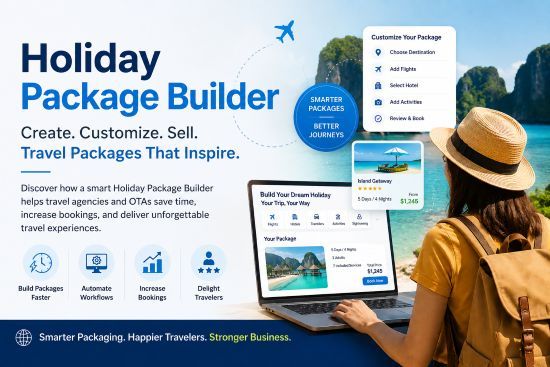
Why Every Travel Agency Needs a Holiday Package Builder in 2026
Learn how Holiday Package Builder Software helps travel agencies and OTAs automate package creation, increase bookings, improve customer experience, and grow revenue.

how to build right travel portal solution for your travel agency
Sopra Travel Technology builds advanced Flight Booking Portals and Travel Technology Platforms designed for travel agencies, OTAs, consolidators, tour operators, startups, and enterprise travel companies worldwide.