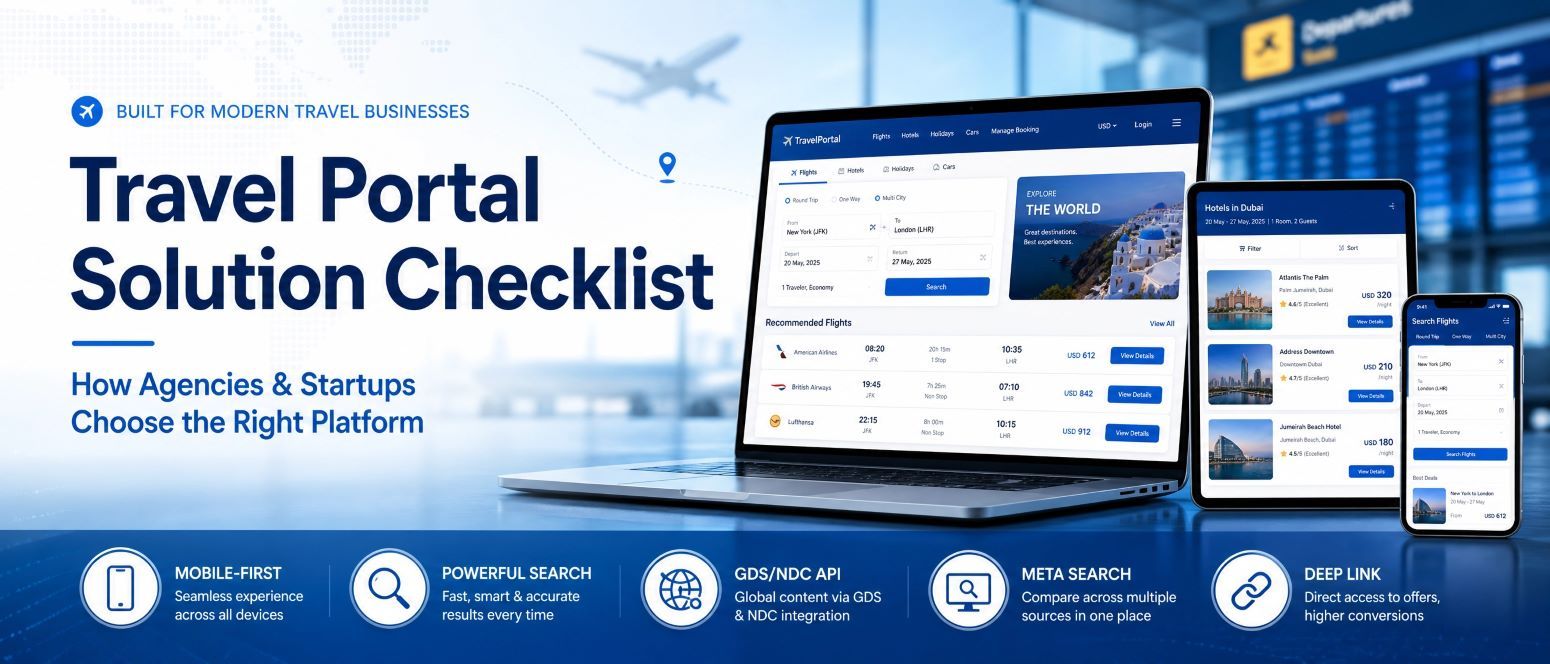
Travel Portal Solution Checklist: How Travel Agencies & Startups Choose the Right Travel Portal Solution
Launching a successful Online Travel Agency (OTA), airline booking platform, or travel startup requires much more than an attractive website. The travel technology partner you choose today will determine how quickly you can scale, integrate new suppliers, manage pricing, reduce operational costs, and compete in an increasingly digital marketplace.
Many travel businesses invest in technology without fully understanding its limitations. As a result, they often face challenges such as slow booking engines, poor supplier connectivity, limited customization, high maintenance costs, and an inability to scale when business grows.
Everything Travel Agencies & Startups Must Verify Before Selecting a Travel Portal Solution
Before selecting a travel technology company, use the following checklist to ensure your investment supports both your current needs and future growth.
1. Mobile-First and Responsive Travel Booking Platform
Modern travelers book from smartphones, tablets, laptops, and desktops. Your booking engine should provide a seamless experience across all devices without requiring separate development efforts.
Look for:
- Fully responsive design
- Mobile-first user experience
- Fast page loading
- Progressive Web App (PWA) support
- Cross-browser compatibility
A single codebase serving all devices reduces maintenance costs and improves customer experience.
2. Powerful Search & Filtering Capabilities
Search functionality directly impacts booking conversions.
Your travel portal should support:
- Flexible date search
- Nearby airport search
- Cabin class filtering
- Multi-city itineraries
- Airline filtering
- Stopover filtering
- Departure and arrival time filtering
- Price range filtering
Customers should be able to find the most relevant travel options within seconds.
3. GDS, NDC, and Third-Party API Integration
Supplier connectivity is the foundation of any travel business.
Ensure your platform supports integration with:
Global Distribution Systems (GDS)
- Amadeus
- Travelport
- Sabre
NDC Connectivity
Airlines are increasingly distributing exclusive fares and ancillary services through NDC channels.
A future-ready platform should support:
- Amadeus NDC
- Sabre NDC
- Travellport GDS (Galileo)
- Direct airline NDC APIs
Alternative Suppliers
- TravelFusion
- PKFARE
- Mystifly
- Mondee
- Hotel APIs
- Transfer APIs
- Car Rental APIs
For startups, consolidator APIs often provide a faster and more cost-effective path to market than direct GDS contracts.
4. Meta Search Integration Support
Customer acquisition is becoming more expensive every year.
Your travel portal should support integration with major metasearch platforms, enabling real-time fare and availability distribution.
Examples include:
- Skyscanner
- Google Flights
- Kayak
- Cheapflights
- JetCost
- WeGo
- Farecompare
This functionality can significantly increase booking volume while lowering customer acquisition costs.
5. Deep Link Integration Capability
Deep linking allows marketing partners and deal websites to redirect highly qualified traffic directly into pre-filled search results.
Your platform should support:
- Search parameter passing
- Dynamic route mapping
- Campaign tracking
- Conversion attribution
Deep-link integrations are critical for affiliate and performance marketing strategies.
6. Scalability and High-Traffic Performance
A booking engine that performs well with 100 users may fail under 10,000 users.
Ask your technology provider:
- Has the platform been load tested?
- What is the average search response time?
- How many concurrent users can it support?
- Is the infrastructure cloud-native?
Look for platforms deployed on scalable cloud infrastructure such as AWS, Azure, or Google Cloud.
7. Dynamic Pricing, Markup & Discount Management
Revenue optimization requires complete pricing flexibility.
Your platform should allow:
- Route-based markups
- Airline-specific pricing rules
- Cabin-class pricing adjustments
- Promotional discounts
- Agent-level pricing
- Customer segment pricing
A strong pricing engine can become a major competitive advantage.
8. Supplier Routing and Inventory Control
As your supplier network grows, inventory management becomes increasingly complex.
A mature travel booking platform should allow:
- Supplier prioritization
- Route-specific supplier selection
- Airline-specific sourcing rules
- Inventory suppression
- Preferred supplier routing
This helps maximize profitability and booking success rates.
9. Offline Fare Management
Many travel agencies negotiate exclusive deals directly with airlines and consolidators.
Your platform should support:
- Offline fare uploads
- Private fare management
- Corporate fare distribution
- Fare synchronization
- Distribution across web, mobile, and affiliate channels
This allows agencies to monetize unique inventory not available publicly.
10. Payment Gateway Integration & PCI Compliance
Security and trust are critical in travel eCommerce.
Verify support for:
- Multiple payment gateways
- Multi-currency payments
- Tokenization
- PCI-DSS compliance
- Secure card storage
- Fraud detection systems
Payment flexibility directly impacts booking conversion rates.
11. Fraud Prevention and Chargeback Protection
Travel is one of the most targeted industries for payment fraud.
Your technology platform should support integrations with:
- Riskified
- Signifyd
- Kount
- FraudLabs Pro
Advanced fraud prevention can save thousands of dollars in chargebacks annually.
12. Multi-Channel Distribution Support
Modern travel businesses sell through multiple channels.
Your platform should support:
- B2C websites
- B2B agent portals
- Corporate booking tools
- Affiliate networks
- Mobile applications
- API distribution
A centralized platform ensures consistent inventory and pricing across all channels.
13. SEO and Marketing Readiness
Many travel portals are technically functional but invisible on search engines.
Your platform should support:
- SEO-friendly URLs
- Schema markup
- Dynamic landing pages
- Blog integration
- XML sitemap generation
- Fast Core Web Vitals performance
Technology should help generate organic traffic, not depend entirely on paid advertising.
14. AI Readiness and Automation
AI is transforming the travel industry.
Ask whether the platform supports:
- AI-powered customer support
- Chatbots
- Automated itinerary generation
- Personalized recommendations
- Smart search
- Agent productivity tools
Travel businesses adopting AI early will gain significant operational advantages.
15. Reporting and Business Intelligence
Data-driven decisions improve profitability.
Ensure your platform provides:
- Real-time dashboards
- Supplier performance reports
- Route profitability reports
- Booking analytics
- Conversion tracking
- Customer behavior insights
Good reporting turns data into revenue opportunities.
16. Vendor Lock-In Protection
One of the most overlooked factors is portability.
Ask your technology provider:
- Who owns the source code?
- Can suppliers be changed easily?
- Can new APIs be added later?
- Can data be exported?
Your business should never become dependent on a single technology vendor.
Final Thoughts
Selecting a travel technology company is one of the most important decisions for any travel agency, OTA, consolidator, or startup.
The right travel portal solution should not only meet today's requirements but also support future growth through scalability, supplier flexibility, NDC connectivity, AI readiness, security, and multi-channel distribution.
Before signing any agreement, evaluate your technology partner against this checklist. A strong technology foundation will help you acquire more customers, increase conversions, reduce operational costs, and build a sustainable travel business for years to come.
Need help evaluating your current travel technology stack or planning a new OTA platform? Contact our travel technology experts for a free consultation.
Considering the next evolution of your booking architecture?
We invite you to an open, confidential discussion about your strategic goals. Together, we can review your existing infrastructure, explore modern solutions that align with your vision, and draft a high-level roadmap for your next phase of growth—with absolutely no obligation to partner with us.
View More Articles

Sabre API Integration for Tour Operators
Discover how Sabre API integration can help tour operators build flight, hotel, cruise and multi-product booking platforms with scalable travel technology.

Sabre Api Integration Guide
Learn how Sabre API integration works for travel businesses. Explore flight search, booking, PNR management, architecture, certification requirements, challenges and implementation planning.

Launch Online Travel Business Without White Label
Launch an Online Travel Business in One Week Without Being Locked Into a White-Label Platform

How to Start an Online Flight Booking Business
Learn how to start an online flight booking business with limited upfront investment, including GDS/API options, technology costs, MVP strategy and partnership models.

Holiday Program Booking Software For Travel Agents And OTAS
Discover holiday program booking software with a powerful B2C & B2B holiday package builder. Let customers create, customize, and book holiday packages online.

Travel Portal Solution Comparison Guide
Travel Portal Solution Comparison Guide: How to Choose the Right Platform for Your Travel Business

Airline Reservation System Trends 2026 and Beyond
Elevating Air Travel: The Indispensable Role of Advanced Airline Reservation Systems in 2026 and Beyond

Why Every Travel Agency Needs a Holiday Package Builder in 2026
Learn how Holiday Package Builder Software helps travel agencies and OTAs automate package creation, increase bookings, improve customer experience, and grow revenue.

how to build right travel portal solution for your travel agency
Sopra Travel Technology builds advanced Flight Booking Portals and Travel Technology Platforms designed for travel agencies, OTAs, consolidators, tour operators, startups, and enterprise travel companies worldwide.

How to Start an Online Travel Agency OTA in 2026
The global travel industry has changed dramatically over the last few years. Travelers now expect instant flight search, real-time pricing, mobile booking, secure payments, and personalized travel experiences - all from a single platform.
FAQs (Frequently Asked Questions)
What should travel agencies look for when choosing a travel technology partner?
Travel agencies should evaluate supplier connectivity, GDS and NDC support, scalability, payment security, customization options, mobile responsiveness, reporting capabilities, and ongoing technical support. The ideal travel technology partner should support both current business requirements and future growth plans.
What is a travel portal solution?
A travel portal solution is a software platform that enables travel agencies, OTAs, and tour operators to search, compare, book, and manage travel products such as flights, hotels, transfers, car rentals, and holiday packages through a centralized system.
What is the difference between GDS and NDC in travel technology?
A Global Distribution System (GDS) such as Amadeus, Sabre, or Travelport aggregates travel inventory from multiple suppliers. NDC (New Distribution Capability) is an airline-driven standard that allows airlines to distribute richer content, ancillary services, and exclusive fares directly to travel sellers through modern APIs.
Do travel startups need direct GDS access from day one?
Not necessarily. Many travel startups begin with consolidator APIs or third-party travel suppliers because they require lower investment and faster onboarding. Direct GDS connectivity can be added later as booking volumes increase and commercial agreements become viable.
Why is API integration important for an online travel agency (OTA)?
API integration enables real-time access to flight, hotel, transfer, car rental, payment, and ancillary service providers. A well-integrated OTA platform can offer more inventory, better pricing, improved booking accuracy, and a superior customer experience.
How can travel agencies increase bookings through metasearch integration?
Metasearch integration allows agencies to distribute fares and availability to platforms such as Skyscanner and Kayak. This increases visibility, attracts high-intent travelers, and can significantly improve booking volume while reducing dependence on traditional advertising channels.
What security features should a travel booking platform include?
A secure travel booking platform should provide PCI-DSS compliance, SSL encryption, tokenized payment processing, fraud detection tools, chargeback protection, secure customer authentication, and regular security monitoring to protect customer data and transactions.
How important is scalability in travel technology?
Scalability is critical because travel businesses often experience seasonal demand spikes and rapid growth. A scalable cloud-based platform can handle increased traffic, search requests, bookings, and supplier integrations without compromising performance or customer experience.
Can AI improve the performance of travel booking platforms?
Yes. AI-powered travel solutions can automate customer support, provide personalized recommendations, optimize pricing strategies, improve search relevance, generate itineraries, and help travel businesses reduce operational costs while increasing customer satisfaction.
How do I know if a travel portal solution is future-ready?
A future-ready travel portal should support GDS and NDC connectivity, API-first architecture, cloud deployment, multi-channel distribution, AI integration, advanced reporting, mobile optimization, cybersecurity compliance, and the ability to add new suppliers and features without major redevelopment.
How much does it cost to develop a travel booking platform?
The cost of developing a travel booking platform depends on the scope of features, supplier integrations, customization requirements, mobile applications, payment gateway integrations, and distribution channels. A basic OTA solution may cost significantly less than an enterprise-grade platform with GDS, NDC, B2B, B2C, and multi-supplier capabilities. Most agencies benefit from starting with a scalable foundation and expanding as their business grows.