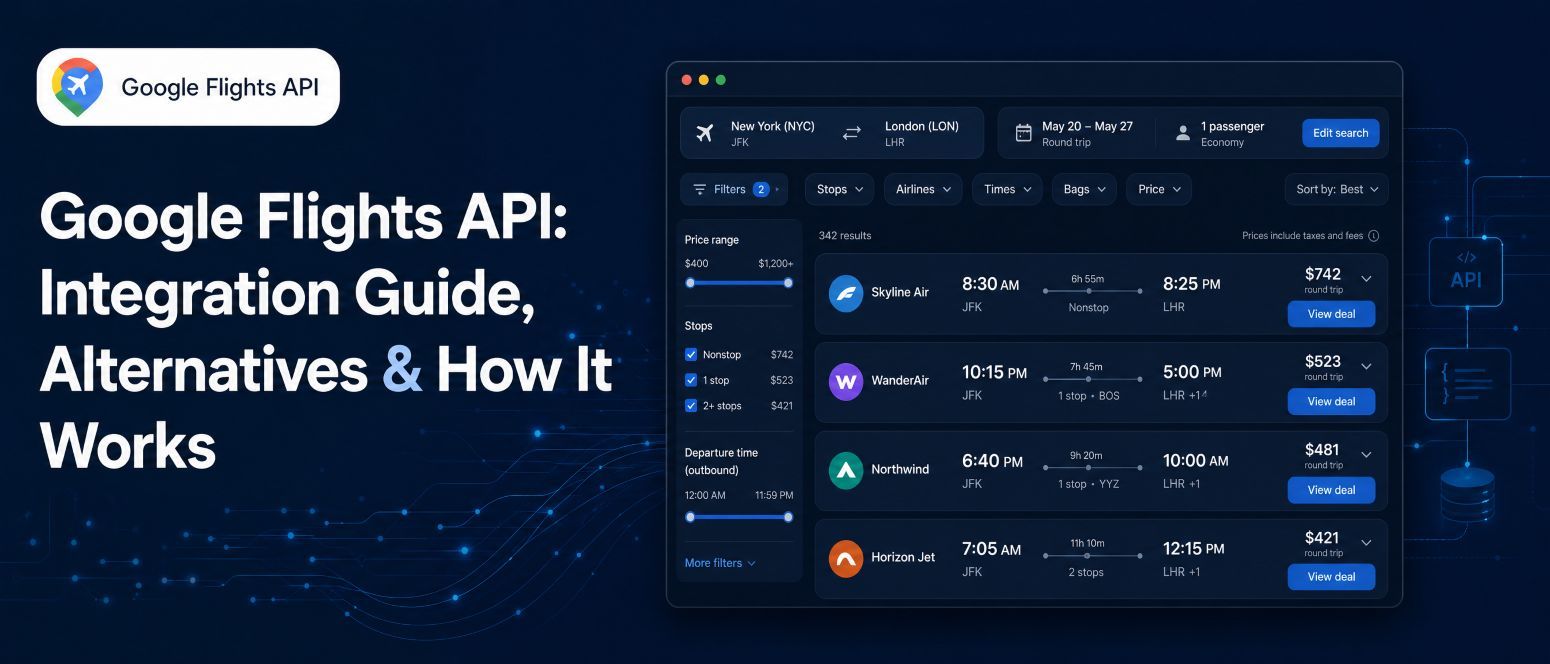
Google Flights API: Integration Guide, Alternatives & How It Works
If you are searching for Google Flights API, you may be trying to answer one of several questions:
- Does Google provide an official Google Flights API?
- Can an OTA access Google Flights flight data through an API?
- How can I integrate my flight booking platform with Google Flights?
- Can Google Flights send travelers directly to my booking engine?
- How does live flight pricing work on Google Flights?
- Is there a Google Flights API alternative for developers?
The answer is more nuanced than simply finding an API endpoint and connecting it to your application.
Google Flights is a flight metasearch platform that connects travelers with airlines, online travel agencies and other travel partners. Google provides partner integration mechanisms for eligible businesses, but it should not be treated like a conventional public flight-booking API that any developer can simply register for and start calling.
For travel businesses, the real technical challenge is usually not "getting a Google Flights API."
It is building the integration layer between Google Flights, your flight inventory, your pricing system and your booking engine.
This guide explains how Google Flights API and integration actually work, what options are available, and what an OTA or travel technology company should consider before starting development.
What Is Google Flights?
Google Flights is Google's flight metasearch service.
Instead of being a traditional airline reservation system or GDS, Google Flights helps travelers discover and compare flight options from airlines, OTAs and other travel partners.
The traveler searches for an itinerary, compares available options and then selects a booking option.
The booking journey can then continue to the airline or travel partner's website.
This distinction is important.
Google Flights is not a GDS
A GDS such as Amadeus, Sabre or Travelport provides access to travel inventory and reservation-related functionality.
Google Flights operates at a different layer.
A simplified travel technology ecosystem looks like this:
Airlines → GDS / NDC / Direct APIs → OTA Booking Platform → Google Flights / Metasearch
An OTA may therefore use its existing GDS, NDC or airline integrations as the source of flight inventory while building the technology required to participate in a Google Flights integration.
Is There an Official Google Flights API?
This is one of the most common questions from developers.
There is no conventional public Google Flights API that works like a typical self-service flight-search API where you simply create an account, obtain an API key and start querying Google Flights inventory.
Google provides Google Flights Search partner documentation for airlines and OTAs. The documentation is intended for selected partners and includes partner-specific integration requirements.
This means that businesses should be careful when they see websites advertising a "Google Flights API."
There are several completely different things that can be described using that term:
- Official Google Flights partner integration
- Third-party extraction APIs
- Flight search APIs
- GDS and NDC APIs
- Custom metasearch integration middleware
These solutions are not interchangeable.
How Does Google Flights Integration Work?
A typical Google Flights integration can involve several technical components.
At a high level:
Traveler searches Google Flights
↓
Google identifies relevant flight solutions
↓
Booking options are displayed
↓
Traveler selects an airline or OTA
↓
Google sends the traveler to the partner's booking journey
↓
Partner website continues the booking process
The important part for an OTA is what happens between the Google Flights search and the partner website.
The booking journey should ideally preserve the selected itinerary rather than simply sending the customer to a generic homepage and asking them to search again.
This is where deep linking, itinerary matching and booking-engine integration become important.
What Is a Google Flights Deep Link?
A deep link allows a traveler to move from a selected flight on Google Flights toward the corresponding booking journey on the partner's website.
For example, imagine a traveler searches:
London → Dubai
15 October
Return: 25 October
Economy
1 Adult
The objective is not simply to send the traveler to:
yourwebsite.com
Instead, the integration should allow the selected itinerary and relevant search context to be carried into the appropriate booking workflow.
A properly designed deep-link journey can reduce friction because the traveler does not necessarily have to repeat the entire flight search.
For an OTA, this can require:
- Origin and destination mapping
- Date processing
- Passenger information
- Cabin-class mapping
- Flight and segment identification
- Carrier identification
- Flight-number matching
- Itinerary reconstruction
- Search parameter processing
- Booking-engine routing
- Currency and locale handling
- Error handling
- Fallback logic
This is why Google Flights integration is primarily a travel technology integration project, rather than simply an API-development exercise.
Why Live Flight Pricing Matters?
Flight prices are dynamic.
A price that exists during one search can change because of:
- Inventory availability
- Fare-class availability
- Passenger count
- Taxes
- Currency
- Fare rules
- Airline pricing
- Booking class
- Time of search
- Supplier response
For a metasearch integration, showing a price is not enough.
The price needs to remain sufficiently accurate when the traveler moves from the comparison experience to the partner booking website.
This creates an important technical requirement:
Search → Match → Validate → Price → Book
The integration architecture should therefore be capable of validating the selected itinerary and retrieving current pricing where required.
Google Flights Price Accuracy
Price accuracy is one of the most important considerations in Google Flights integration.
Google's Travel Analytics documentation includes a specific quality metric called Price Discrepancy.
Google defines this as a situation where the price on the partner website differs by more than 2% from the price Google expects.
Google also tracks Itinerary Not Found, where the expected flight solution cannot be found or booked.
For an OTA, these metrics demonstrate an important principle:
Google Flights integration is not successful simply because a booking link exists.
The booking link, itinerary and price need to work together.
What Is an Itinerary-Not-Found Problem?
Imagine that Google displays:
British Airways
London → New York
£425
The traveler clicks the OTA booking link.
But your website opens a search page showing:
No flights found
That is an itinerary-matching problem.
Other examples include:
- Wrong flight number
- Wrong departure time
- Wrong date
- Incorrect airport
- Missing connection
- Different operating carrier
- Different fare class
- Supplier availability changed
- Booking token expired
- Search parameters were incorrectly transformed
These problems can occur even when the underlying flight supplier API is working correctly.
The integration layer therefore needs robust itinerary matching and error handling.
Google Flights API vs Flight Booking API
One of the biggest sources of confusion is the difference between Google Flights integration and a flight booking API.
They solve different problems.
| Requirement | Google Flights | Flight Booking API |
|---|---|---|
| Flight discovery | Yes | Yes |
| Flight comparison | Yes | Depends on API |
| Airline inventory | Aggregated/partner-based | Usually supplier-based |
| Booking | Usually redirects to partner | Often supported |
| GDS connectivity | Not a GDS | Can provide access |
| NDC connectivity | Partner/integration dependent | Can provide access |
| OTA booking engine | Partner destination | Often part of solution |
| Deep linking | Important | Application-dependent |
| Live repricing | Integration-dependent | Usually supported |
| Ticketing | Not simply a Google Flights API function | Supported by appropriate suppliers |
This is why an OTA should first identify the actual business requirement.
If your objective is:
"I want to sell flights."
You may need Amadeus, Sabre, Travelport, NDC or another flight inventory provider.
If your objective is:
"I want my OTA to participate in Google Flights."
You need to investigate the applicable Google partner requirements and build the required integration around your booking infrastructure.
If your objective is:
"I want to retrieve Google Flights search results programmatically."
You are looking at a different category of solution, such as a third-party data extraction service, and you should carefully evaluate its terms, reliability, coverage and suitability for your intended use.
What About Third-Party Google Flights APIs?
Several third-party providers market APIs that return structured Google Flights search results.
These can be useful for specific applications such as:
- Flight research
- Fare comparison
- Travel analytics
- Price monitoring
- Market intelligence
- Travel search applications
- AI travel assistants
However, developers should understand the distinction.
A third-party Google Flights data API is not automatically equivalent to an official Google Flights partner integration.
It may provide structured search data without providing:
- Google partner status
- Official booking integration
- Airline ticketing
- GDS access
- NDC access
- Your own OTA booking workflow
- Guaranteed parity with your booking inventory
For a commercial OTA, the technical and commercial requirements should therefore be evaluated before selecting an API.
Can You Build a Google Flights API Yourself?
You can build the technology layer required for an integration, but you cannot simply create your own unofficial "Google Flights API" and assume that it provides official Google Flights partner access.
Instead, an OTA can build a middleware architecture that connects its existing travel technology with the applicable Google Flights integration requirements.
For example:
Google Flights Integration Layer
↓
Flight Search / Pricing Engine
↓
Amadeus / Sabre / Travelport / NDC / Airline APIs
↓
OTA Booking Engine
↓
Payment & Reservation System
The middleware can handle:
- Request validation
- Data transformation
- Flight matching
- Supplier communication
- Pricing
- Repricing
- Response transformation
- Deep-link processing
- Authentication
- Error handling
- Logging
- Monitoring
- Performance optimization
This approach allows an OTA to retain control over its existing booking infrastructure.
Google Flights Integration Architecture for an OTA
A typical architecture could look like this:
Layer 1 — Google Flights
The traveler searches and selects a flight option.
Layer 2 — Integration Middleware
Your integration layer receives and processes the required request or booking context.
Layer 3 — Flight Search and Pricing Engine
The middleware communicates with your internal flight-search system.
Layer 4 — Flight Suppliers
Your system may connect to:
- Amadeus
- Sabre
- Travelport
- NDC aggregators
- Direct airline APIs
- Flight consolidators
- Private fare systems
Layer 5 — Booking Engine
The selected itinerary is mapped into your OTA booking workflow.
Layer 6 — Customer Journey
The traveler continues toward:
- Fare review
- Passenger details
- Ancillaries
- Payment
- Booking confirmation
- Ticketing
The exact architecture depends on the partner integration model and the OTA's existing technology.
What Technology Does an OTA Need Before Google Flights Integration?
Before starting development, an OTA should ideally have a functioning flight technology stack.
At minimum, you should understand:
Flight inventory
Where do your fares come from?
For example:
- GDS
- NDC
- Airline API
- Consolidator
- Aggregator
Search engine
Can your system search:
- One-way
- Round-trip
- Multi-city
- Connecting flights
- Multiple passengers
- Different cabins
Pricing
Can your platform retrieve current pricing?
Repricing
Can the selected itinerary be validated before booking?
Booking
Can the selected itinerary be converted into a reservation?
Deep-link handling
Can your platform reconstruct a specific itinerary from an external booking context?
Performance
Can your infrastructure respond quickly enough for a live integration?
These questions should be answered before building the external integration layer.
Why API Response Time Matters?
Flight search is already a technically demanding process.
A request may need to travel through multiple systems:
Google → Integration Layer → OTA Search Engine → GDS/NDC → Airline/Supplier → OTA → Integration Layer → Google
Every additional network call adds latency.
The integration therefore needs to consider:
- API response time
- Supplier latency
- Parallel supplier requests
- Timeout handling
- Retry strategy
- Caching
- Connection pooling
- Database performance
- Logging
- Monitoring
- Failure handling
For live pricing integrations, performance engineering can become just as important as API development.
Google Flights Integration Is More Than an API Connection
This is probably the most important lesson for businesses evaluating Google Flights integration.
A technically valid API connection does not automatically create a successful metasearch integration.
You need to think about the complete customer journey:
Discovery
↓
Flight matching
↓
Price accuracy
↓
Booking-link quality
↓
Landing page
↓
Revalidation
↓
Passenger details
↓
Payment
↓
Ticketing
Each stage can introduce a failure.
Google's own Travel Analytics tools provide partner-facing visibility into pricing, booking-link performance, participation and referrals.
That means a mature integration should be treated as an ongoing technology and optimization project rather than a one-time API connection.
Google Flights API Alternatives
If you are looking for a "Google Flights API alternative," first define what you actually need.
Option 1 — GDS APIs
Suitable when your objective is to access flight inventory and build a booking system.
Common providers include:
- Amadeus
- Sabre
- Travelport
These can provide access to flight search, pricing and booking capabilities depending on the commercial agreement and API product.
Option 2 — NDC APIs
NDC can provide access to airline content and offers through airline or NDC aggregation channels.
This can be particularly relevant when an OTA wants richer airline content or direct airline distribution.
Option 3 — Direct Airline APIs
Some airlines provide their own API or distribution channels.
This can provide direct access to particular airline inventory, but it requires individual airline relationships and technical integration.
Option 4 — Third-Party Google Flights Data APIs
These services can provide structured Google Flights search data for applications where the objective is data retrieval rather than official Google partner distribution.
They should be evaluated separately from official Google Flights integration.
Which API Should You Choose?
There is no single "best Google Flights API" for every travel business.
The right technology depends on your objective.
If you are:
Building an OTA booking engine
→ Evaluate GDS, NDC, airline and flight aggregator APIs.
Building a flight comparison application
→ Evaluate flight-search and metasearch data APIs.
Trying to distribute your OTA through Google Flights
→ Investigate Google's applicable partner integration requirements.
Building an AI travel assistant
→ Consider combining flight search APIs with your own itinerary, pricing and booking orchestration layer.
Building a travel analytics platform
→ Evaluate structured flight-data providers based on coverage, freshness, reliability and permitted usage.
The important point is to avoid selecting an API purely because its marketing page contains the words "Google Flights API."
Google Flights API Integration for Existing OTAs
If your OTA already has a working flight booking engine, you may not need to rebuild the entire platform.
A custom integration layer can potentially sit between the existing systems and the required external workflow.
For example:
Existing OTA
- Flight search
- GDS APIs
- NDC
- Pricing engine
- Booking engine
- Payment gateway
Custom Google Flights Integration Layer
- Request processing
- Data mapping
- Itinerary matching
- Live pricing
- Deep links
- Validation
- Error handling
This approach can reduce unnecessary changes to the existing booking infrastructure.
Google Flights Integration with Amadeus, Sabre and Travelport
Many OTAs already use one or more major GDS platforms.
The Google Flights integration layer can be designed around an existing supplier architecture.
For example:
Amadeus
The integration layer can connect the required flight-search and pricing workflow with an existing Amadeus-based booking engine.
Sabre
An existing Sabre flight-search and reservation system can be incorporated into the architecture.
Travelport
Travelport-based booking platforms can similarly be connected through a custom middleware layer.
Multiple Suppliers
For larger OTAs, the integration may involve multiple suppliers.
For example:
Google Flights
↓
Sopra Integration Middleware
↓
Supplier Orchestration
↓
Amadeus + Sabre + Travelport + NDC
↓
OTA Booking Engine
This type of architecture can give the OTA greater control over supplier selection, pricing and fallback logic.
Common Google Flights Integration Mistakes
1. Assuming Google Flights is a public API
This is the first mistake.
Google Flights should not be treated like a conventional self-service flight API.
2. Focusing only on search
A flight appearing in search is not enough.
The selected itinerary must continue into a usable booking journey.
3. Ignoring price accuracy
A price shown on Google that changes substantially on the partner website can create a poor customer experience.
4. Sending users to the homepage
A generic homepage forces the traveler to repeat the search.
Where the integration model supports it, a relevant deep-link journey can provide a much better experience.
5. Ignoring itinerary matching
Flight number, airport, date, time, carrier and fare information may all matter.
6. Building without understanding the existing OTA
Replacing a functioning booking engine unnecessarily can increase cost and complexity.
7. Treating the project as a one-time integration
Flight suppliers, APIs, pricing systems and partner specifications evolve.
Monitoring and optimization should be part of the architecture from the beginning.
How Sopra Travel Technology Approaches Google Flights Integration?
Sopra Travel Technology approaches Google Flights integration as a travel technology engineering project, rather than selling access to a supposed public Google Flights API.
We can work with businesses that already have:
- An OTA
- Flight booking engine
- GDS integration
- NDC integration
- Airline APIs
- Flight consolidator APIs
- Custom reservation systems
- Existing pricing engines
Depending on the project requirements, the technology layer can include:
- Google Flights integration architecture
- Deep-link development
- Live pricing API development
- Flight itinerary matching
- Fare validation
- Repricing workflows
- GDS integration
- NDC integration
- Airline API integration
- Request/response transformation
- REST API development
- JSON mapping
- Authentication
- Timeout handling
- Error management
- Logging and monitoring
- Performance optimization
- Production deployment
The objective is to connect the external integration requirements with the travel technology that already powers your business.
Do You Need a New Booking Engine?
Not necessarily.
If you already operate a functional OTA booking platform, the first step should be a technical assessment.
We would normally look at:
- Existing flight suppliers
- Flight search architecture
- Pricing and repricing
- Booking workflow
- API architecture
- Itinerary identification
- Deep-link capability
- Infrastructure
- Performance
- Monitoring and error handling
Only after understanding the existing system should, you decide whether you need a new booking engine or simply a dedicated integration layer.
FAQ's
Is there a free Google Flights API?
There is no conventional public Google Flights API that developers can simply register for and use like a standard self-service flight API. Google provides partner integration documentation for eligible/select partners.
Can I get Google Flights data through an API?
Third-party services provide structured access to Google Flights search data. However, this is different from official Google Flights partner integration and should be evaluated according to your specific use case.
Does Google Flights provide flight booking?
Google Flights functions primarily as a metasearch and discovery experience. Travelers can select booking options and continue to airline or OTA websites.
Can an OTA integrate with Google Flights?
Yes, eligible OTAs can participate through applicable Google Flights partner integration processes and technical requirements.
Can I connect Amadeus to Google Flights?
An OTA can build an integration architecture where its existing Amadeus-based flight inventory and booking technology support the applicable Google Flights workflow. The exact implementation depends on the Google partner integration requirements and the OTA's existing system.
Can I connect Sabre to Google Flights?
Yes, the same architectural principle can apply to an existing Sabre-based flight platform. A custom integration layer can connect the required external workflow with the OTA's existing Sabre infrastructure.
Can I connect Travelport to Google Flights?
An existing Travelport-based booking platform can similarly be incorporated into a custom Google Flights integration architecture.
What is a Google Flights deep link?
A deep link is a booking link designed to take a traveler from a selected flight on Google Flights into the relevant booking journey on the partner website, rather than requiring the traveler to repeat the search.
Is Google Flights API the same as Amadeus API?
No.
Google Flights is a metasearch platform, while Amadeus provides travel inventory and booking-related APIs. They operate at different levels of the travel technology ecosystem.
How much does Google Flights API integration cost?
There is no universal integration price.
The cost depends on factors such as:
- Existing OTA architecture
- GDS/NDC suppliers
- Number of suppliers
- Pricing workflow
- Deep-link requirements
- API complexity
- Itinerary matching
- Testing requirements
- Infrastructure
- Monitoring
- Production support
A technical assessment is usually the right starting point before estimating development effort.
Final Thoughts
Searching for Google Flights API can lead to a lot of confusing information.
The most important distinction is between:
Google Flights partner integration
and
third-party APIs that retrieve Google Flights data.
They are different technical and commercial solutions.
For an OTA, the bigger question is not simply:
"How do I get a Google Flights API?"
The better question is:
"How do I connect my flight inventory, pricing engine and booking platform with the Google Flights ecosystem in a technically reliable way?"
That requires an understanding of flight search, GDS/NDC integration, pricing, itinerary matching, deep linking, API performance and booking workflows.
If your business already has a flight booking platform, you may not need to replace it. A purpose-built integration layer can potentially connect your existing travel technology with the required Google Flights workflow.
Need Help with Google Flights Integration?
Sopra Travel Technology develops custom flight integration and travel technology solutions for OTAs, airlines, travel agencies and travel businesses.
If you already have a flight booking engine, GDS/NDC connection or airline API and need to understand how Google Flights integration could fit into your architecture, our team can review your existing technology and help define the appropriate integration approach.
Explore our Google Flights Integration Services →
Talk to Sopra Travel Technology about your flight integration requirements →
Considering the next evolution of your booking architecture?
We invite you to an open, confidential discussion about your strategic goals. Together, we can review your existing infrastructure, explore modern solutions that align with your vision, and draft a high-level roadmap for your next phase of growth—with absolutely no obligation to partner with us.
View More Articles

Sabre API Integration for Tour Operators
Discover how Sabre API integration can help tour operators build flight, hotel, cruise and multi-product booking platforms with scalable travel technology.

Sabre Api Integration Guide
Learn how Sabre API integration works for travel businesses. Explore flight search, booking, PNR management, architecture, certification requirements, challenges and implementation planning.

Launch Online Travel Business Without White Label
Launch an Online Travel Business in One Week Without Being Locked Into a White-Label Platform

How to Start an Online Flight Booking Business
Learn how to start an online flight booking business with limited upfront investment, including GDS/API options, technology costs, MVP strategy and partnership models.

Holiday Program Booking Software For Travel Agents And OTAS
Discover holiday program booking software with a powerful B2C & B2B holiday package builder. Let customers create, customize, and book holiday packages online.

Travel Portal Solution Comparison Guide
Travel Portal Solution Comparison Guide: How to Choose the Right Platform for Your Travel Business

Airline Reservation System Trends 2026 and Beyond
Elevating Air Travel: The Indispensable Role of Advanced Airline Reservation Systems in 2026 and Beyond

Travel Portal Solution Checklist
Choosing the Right Travel Technology Partner? 16 Questions Every Travel Agency & OTA Should Ask Before Choosing a Technology Partner & Avoid Costly Mistakes.

Why Every Travel Agency Needs a Holiday Package Builder in 2026
Learn how Holiday Package Builder Software helps travel agencies and OTAs automate package creation, increase bookings, improve customer experience, and grow revenue.

how to build right travel portal solution for your travel agency
Sopra Travel Technology builds advanced Flight Booking Portals and Travel Technology Platforms designed for travel agencies, OTAs, consolidators, tour operators, startups, and enterprise travel companies worldwide.